
Prospectus Draft: Can we study theory without history?
Answer: we can't.

In my final paper, I will answer the question: Can we study theory without history? I don’t think that we can study theory without history as theories are formed out of specific moments in time, such as Laura Mulvey’s “Visual Pleasure and Narrative Cinema” and queer theory being formed during the 1970s gay liberation movement, which wouldn't have been possible before Stonewall but began to be taken seriously in the 1990s. Martin Scorsese once said that “we can’t know where we’re going unless we know where we’ve been. We can’t understand the future or the present until we’ve had some sort of grappling with the past.” Learning theory alongside history allows us to understand cinema much better.
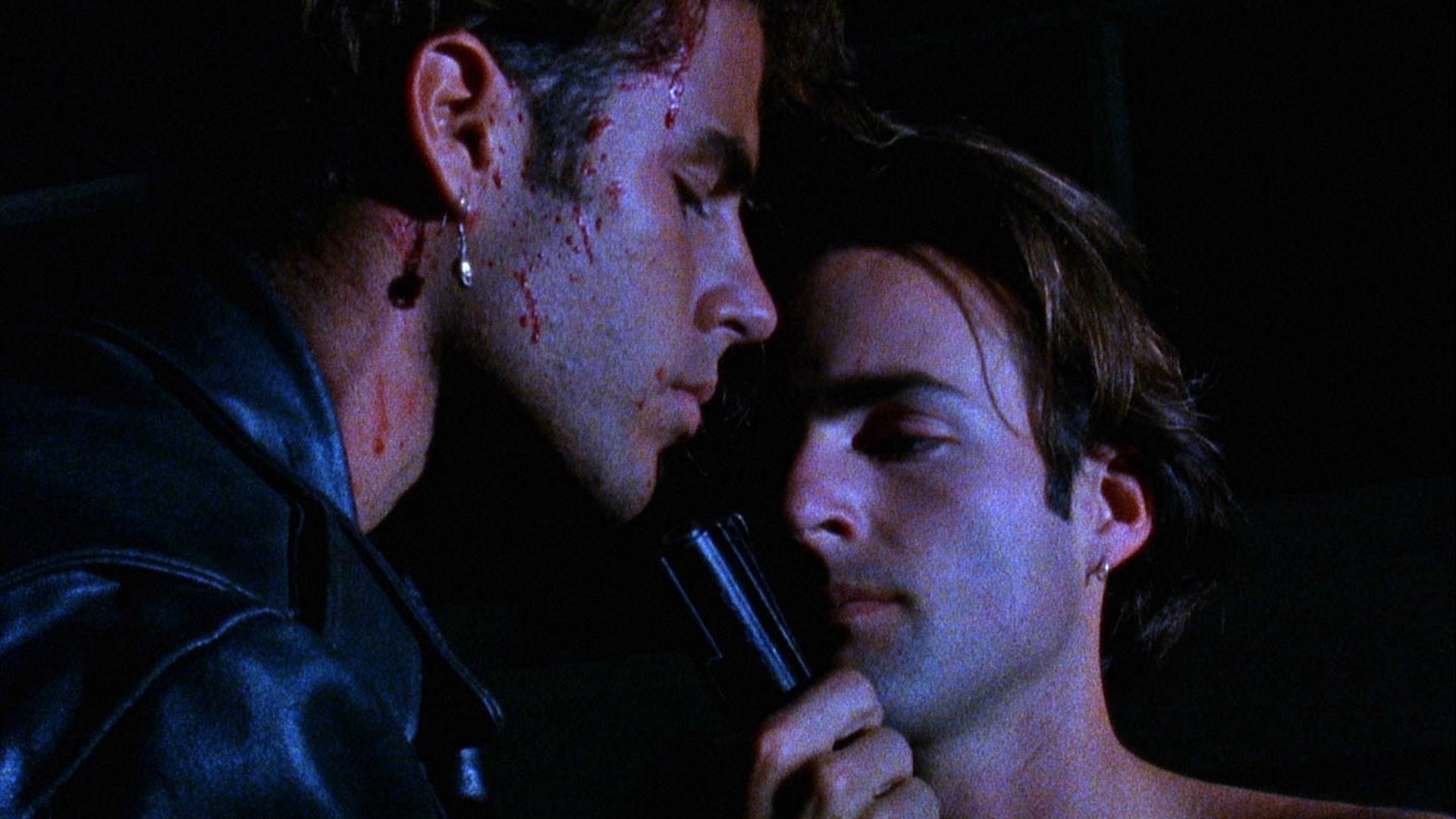
Using The Living End (1992) by Gregg Araki, I will prove my argument that we cannot must study theory alongside history. Greatly inspired by Jean-Luc Godard, the film follows film critic Jon (Craig Gilmore) after he is diagnosed with HIV and how he ends up on the run with Luke (Mike Dytri), an HIV-positive gay male hustler, after Luke kills a homophobic cop. Much of this film would not make sense if someone were not well-versed in HIV-positive culture, queer politics of the 1990s, and the history of the AIDS crisis and how differently HIV/AIDS affected gay boomers and Generation X. I will use feminist and queer theories to make my argument.
Annotated Bibliography
Bordo, Susan. “It’s Not the Same for Women.” The Chronicle of Higher Education, 2013, www.chronicle.com/article/its-not-the-same-for-women/?bc_nonce=kegppbh8il38ruigqyzzd&cid=reg_wall_signup.
In this article, Susan Bordo discusses how cultural criticism is time-sensitive, meaning that it has an expiration date. She goes on to say that theory offers a framework for study that should be applicable across time. Bordo grapples with the legacy of Laura Mulvey’s “Visual Pleasure and Narrative Cinema” and how she looks at her theory and cultural criticism the same way: in their historical contexts. This will help prove my argument because I believe that theories are products of and responses to the times in which they were developed and that a deeper, fuller understanding of cinema is impossible without studying history.
Castiglia, Christopher, and Christopher Reed. “Battles over the Gay Past.” If Memory Serves: Gay Men, AIDS, and the Promise of a Queer Past, University of Minnesota Press, Minneapolis, MN, 2011, pp. 39–71.
The first chapter in this book, “Battles over the Gay Past,” references The Living End (1992) and discusses it in the context of Leo Bursani’s influential article, “Is the Rectum a Grave?” The Living End is used as a case study to analyze its spot in history and how it’s an example of what happens when gay men divorce themselves from memory. Reed and Castiglia discuss how one of Luke’s monologues make no sense: both gay boomers and Republicans are responsible for AIDS, instead of one or the other. Luke tries to distance himself from gay boomers, the generation before his own, as he thinks they are responsible for his current predicament.
Freeland, Cynthia A. “Feminist Film Theory.” Encyclopedia of Aesthetics, 1998, www.uh.edu/~cfreelan/courses/femfilm.html.
In this article, Cynthia A. Freeland discusses feminist film theories, starting with Laura Mulvey’s “Visual Pleasure and Narrative Cinema.” I found this article to be helpful as gay/trans rights and feminism are not a separate cause. However, the portrayals of the female characters in The Living End do leave much to be desired as the lesbians who pick up Luke at the beginning is a rather lesbophobic depiction and Jon’s female friend does nothing to move the plot forward and spends much of the film wondering where Jon is.
Mulvey, Laura. “A Spectator Who Left Identity Behind.” The Chronicle of Higher Education, 2015, www.chronicle.com/article/a-spectator-who-left-identity-behind/.
In this article, Laura Mulvey discusses the impacts of her 1975 article, “Visual Pleasure and Narrative Cinema” and comes to terms with its legacy. She states that this article could not have been published before or after as it comes from a specific time and place. That Mulvey claims this helps my argument that we cannot study theory without history. We have to understand the historical contexts in which theories emerged in order to have a deeper understanding of theories and cinema.
Straayer, Chris. “Discourse Intercourse: A Compendium of Sexual Scripts.” Deviant Eyes, Deviant Bodies, Columbia University Press, New York, NY, 1996, pp. 102–159.
In this chapter, Chris Straayer discusses Christian Metz’s belief that all films are fiction and how there is a sexual nature to audience spectatorship, albeit mostly unconscious. He discusses theorizations on sexuality, using films or videos of which many are pornographic. While The Living End (1992) is not pornographic, sex still plays a large role. Also, considering that Deviant Eyes, Deviant Bodies was published four years after the release of The Living End, the discourses around sex are contemporary for the film.
What are the major strengths of this prospectus?
I think it’s so great that you’re placing the theories in their cultural context. I think that your initial thesis would be weaker if you just focused on filmic context instead of the context of the when and why these theories were written, but your explicit interest in the cultural moment of when the theories were written and what they’re responding to is fabulous.
What are some areas for improvement?
Sometimes stupid people have a lack of understanding of context and have dumb ideas about theories and films because they don’t have the context for them. You should talk about that. It’s why your paper is more than just compelling, it’s why it’s important. Defending the impetus for this paper also puts it in a contemporary context and experience, just like how you’re writing about the contexts of the theories you’re writing about. One of your strengths is pointing out the lack of nuance in other’s views of old media, so it would be a great time to exercise your rhetorical strength.
Hi Rob,
I think you’ve done a great job laying out a clear central argument about how historical context is essential for analyzing The Living End through the lens of queer film theory. The thoroughness of your annotated bibliography indicates that you’ve already put a lot of thought into how Bordo, Castiglia and Reed, Freeland, Mulvey, and Straayer’s theories build on or challenge one another, demonstrating the heterogeneous nature of queer theory. It definitely looks to me like your topic is generative enough to produce a rigorous ten-page paper.
One thing you might want to think about is the balance of theory and film analysis in your paper. On the one hand, you should probably add at least one other film/media in order to meet the paper requirements. On the other hand, from what I interpreted from your prospectus, the bulk of your argument seems to focus on The Living Dead as a case study. Since the requirements specify that approximately 70-80% (7-8 pages) of the essay should be focused on film theory, you may want to consider structuring your essay such that the supporting arguments are primarily about theory analysis. In a similar vein, I would be mindful of not devoting too much of your paper explaining the history of queer politics in the 1990s, but rather referring to that history only as it pertains to the theories and to The Living Dead.
Overall, this looks like a thought-provoking topic, and I look forward to seeing how you develop it into a full paper!